PRODUCT MANAGER TOOL: Product Value Canvas for Large Organizations
The other day, I got pulled into an email thread in the middle of a conversation two colleagues were having about an issue with a product release plan, and it was very disorienting. They started talking about the problem as though I was as familiar as they were with all the little stuff that had led to a big problem. I tried to keep up, but eventually had to throw a time out signal and ask them to go back to re-tread the minutiae so I could competently participate in the solution they asked me to help them develop.
This happens ALL THE TIME in product management, particularly when you’re trying to run a product team in a mid- to large-sized organization. You have to engage new partners at every turn - from discovery to development to delivery - and you have to re-educate those partners on everything that came before. It’s extremely important, but it’s exhausting.
There are many flavors of documentation for products to help center and focus teams, but I’ve developed the Product Value Canvas for Large Organizations after years of working to evangelize products through the gauntlet that is enterprise governance.
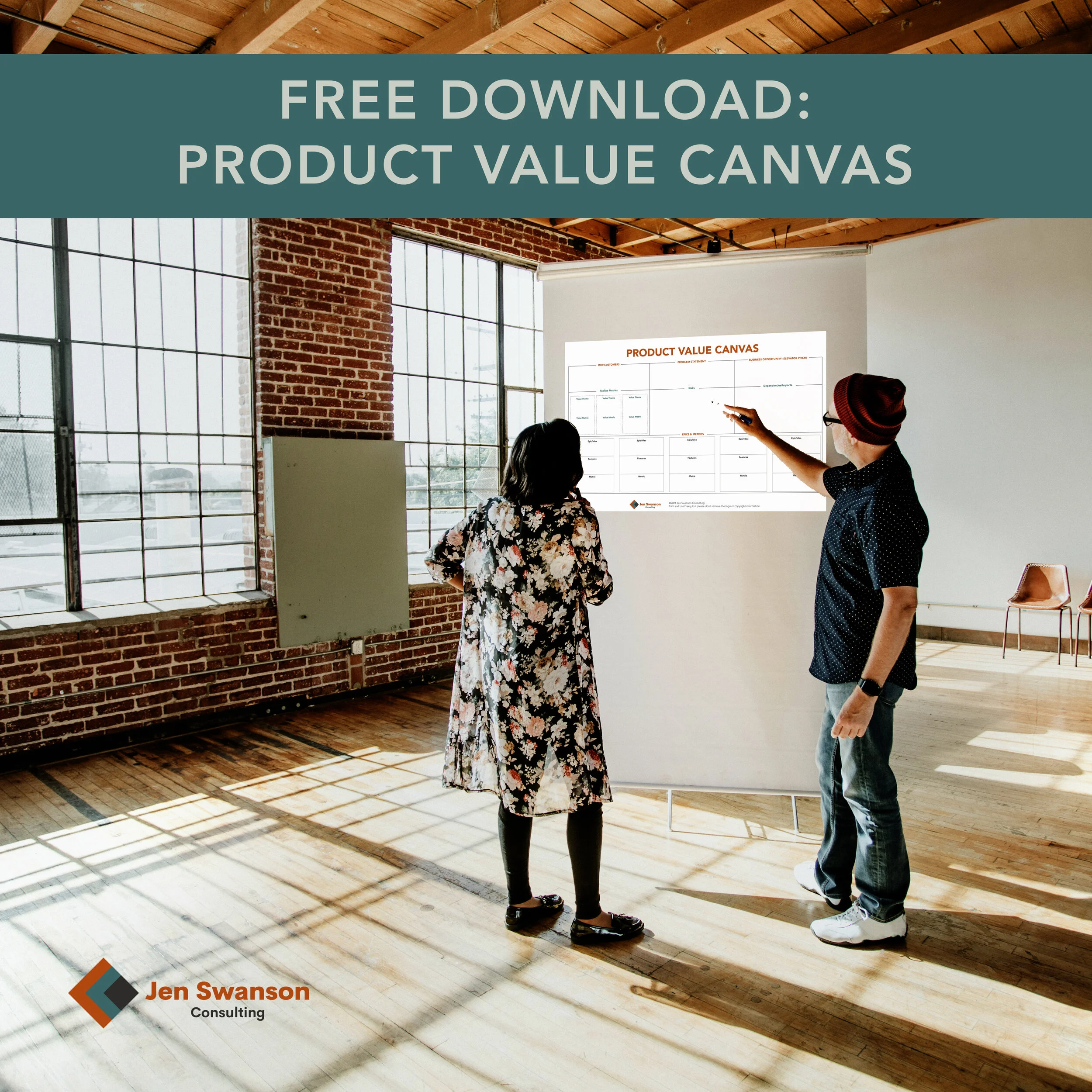
This article is an instructional guide for The Product Value Canvas worksheet. Download the pdf here (sample and full poster versions will be delivered to your inbox).
The thing is, that many product teams never create - or continuously update - a foundational document like a Product Value Canvas because they think that it’s too “waterfall” to be a part of an agile process. But keeping a touchstone document like this at the ready - what problem are we solving, who are we solving it for, and how do we propose to solve it - makes it super easy to ground newcomers to the conversation in what’s gone before.
The Core Elements
Let's take a look at the elements of a foundational Product Value Canvas:
1. What problem you are trying to solve
2. Who you are trying to solve it for
3. How you know if you are solving it in the right way
Getting crystal clear on these three things not only empowers your team to do great work because they are laser focused on the right things, it also makes speedy work of bringing new partners up to speed on what - and why - you’re doing what you’re doing.
The first question should come as no surprise: What problem are you trying to solve?
It’s not as easy as it sounds, however, to get to a succinct description of the problem. Oftentimes, your product is solving many problems, but you have to be clear on the primary issue you are trying to address for your customer, so that your value proposition can be super tight.
An example I like to use is for authentication tools for an app or a website. It’s easy to overlook this as a problem solver (duh, it’s just table stakes, we have to have it but it’s not solving our users real needs). It’s highly complex when you really dig into it: it’s solving the problem of making our customers feel secure about what we’re doing with their personal information. But we also are trying to solve the problem of removing friction for our customers in accessing our services. It’s also protecting the reputation of the company, and limiting cases of fraud. Which of these you narrow in on will have HUGE implications for the kind of authentication your team designs.
Next, you have to define who your customers are, and who your users are: and recognizing that these are not always the same. Don’t get pulled into the trap of just slapping the customer personas you get from Marketing on there. Is there a subset of those segments you’re focused on? Do you understand exactly what their needs are, with relation to the problem you are trying to solve?
In the authentication example from above, you have end-users who will use the sign-in and need to trust you with their information. But an important customer in your work is your internal compliance, fraud, and security teams. You have to find the balance between each to solve the problem you’re trying to address.
Third, you need to articulate what success looks like, by articulating the value that solving the problem for the customers and users you’ve identified and how you’re going to measure it. Again, there’s a trap here: the easy answer is “Revenue!” but in a complex organization, there’s rarely a straight line between your product and top-line growth.
More likely, you’ll have to think about how removing friction from the experience will result in higher usage rates. Or lowered call volume. Or increased self-service rates. Those are the values, and then you can dig further into how you’ll measure your product’s impact on those values.
Once all of this comes together, you can start to craft it into a simple business opportunity statement that answers the question, “So, what are you working on?” when you get some unexpected face time with your favorite CEO. Even better, it’s a short, effective way to get someone up to speed when they enter the conversation in the middle, and they need to get up to speed on what you’re doing and why.
The best way to do this is to create a simple three-sentence paragraph. Sentence one – name the problem. Sentence two – prescribe the solution. Sentence three – what does this make possible?
Example: You know how we see more and more security breaches causing massive losses for companies? I am working with a team to create a more robust and secure login system for our users to keep the bad guys out and let the good guys in quickly and easily.
Keep this statement tight. Don't use insider language. Make it understandable to the layperson.
The Next Level
Once you have these core questions answered, go a level deeper and start working through what progress will look like (AKA your high level road map - ideas, features, and their related metrics), and identifying the risks, dependencies and blockers that might exist inside and outside your organization, relative to the work your team is doing.
Quick note: Nearly every team I work with is surprised by the ask to outline their dependencies and impacts at this stage, but these are always the things that derail product team success. When someone asks me about “Governance” for product teams, I ask: have you made an inventory of everyone your team impacts? Have you made a list of teams that impact you? And when is the last time you actually talked to those people about what you’re doing and when?
There’s no silver-bullet meeting cadence or agenda to compensate for lack of ongoing, intentional communication and collaboration across teams. Making this list is like creating your own call sheet - work the list, and there will be fewer surprises.
How to Use this Completed Document
Great work – you did it! Now, don't just throw it in a binder and forget about it. Put this at the front of every road show, demo, and planning meeting you have, especially when you are including new people in the conversation. Repeat it so often that your stakeholders have it tattooed on the inside of their eyelids. Revise it as needed. It’s a living document.
The download includes an 11x17 version for you to fill in the blanks and use as a poster in your collaboration space, once we have those again. Hang it up for your team to reference often. Talk about the decisions you made and check in on the metrics that show progress. Be clear with your team and others about what you have accomplished, what's next, and what they can expect overall.
I firmly believe this Product Value Canvas is a power tool. It will ensure that you are keeping focused, and makes it easier to ensure everyone in the conversation is speaking from the same core of understanding on the what, why and how of your team.