A New Scorecard That Will Make Product Managers and Key Stakeholders Happy (Mostly)
If you work in the product world you’re probably familiar with a common tension that exists between the product team and key stakeholders.
The former wants to avoid over-promising, being held to unrealistic deadlines, and the monotony of updating status reports.
Their stakeholders, on the other hand, need to know how things are going. Are we making progress on the things we set out to do? What are we learning along the way? Do priorities need to be adjusted? To answer these questions, the scorecard was created.
Now, I totally get why product people can sometimes be anti-scorecard (having been one). I also get why key stakeholders need a peek behind the curtain (having been one of those, as well).
In that spirit, I’ve decided to make some improvements to the typical scorecard that teams use to report on progress. My hope is that it makes both product folks and their stakeholders feel more aligned and maybe, just maybe, a bit happier with the process.
Keep reading to learn about my adjusted scorecard and download the template for free!
What I’m removing from the typical scorecard:
Stoplights: So long, red, yellow and green. While I don’t have a particular vendetta against them, I do think it’s more of a project management way of approaching things (and you know how I feel about trying to project-manage product management).
Deadlines and delivery/launch dates: Assigning specific dates to this work is flatout unhelpful. In fact, it can be downright harmful because it usually results in the weaponization of dates that are held against the product team (it’s no wonder so many product folks have an aversion to exercises like this).
Scorecards should really focus on providing a glimpse into what the team is doing, along with insights around value and KPIs. The new scorecard I created gives people a tangible view of the progress to date without some of the triggers that send Product Managers into a spiral.
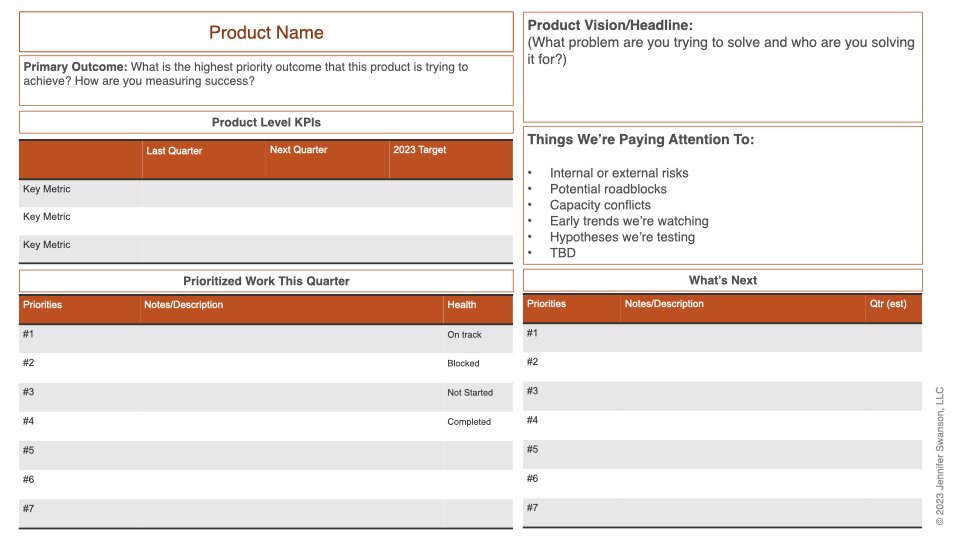
Here’s what’s in my one-page snapshot:
Product Name and Primary Outcome: The product team should remind people what they’re working on. Don’t assume that seeing a roadmap once means your constituents remember what you’re working on (especially since a lot has probably changed since that initial review). Make sure to reiterate how the product is driving support of the broader company goal(s).
Product Vision/Headline: Reiterate what the product does in language that supports the outcomes.
Product-level KPIs: This shows stakeholders that the team is paying attention to initial metrics. It’s okay if they’re just stepping stones to a broader goal (e.g., maybe the ultimate objective is a 40% conversion increase, and today’s update shows the team has achieved a 15% increase).
Prioritized Work This Quarter: Outline the work the team is focused on for the quarter and where each initiative stands (e.g., completed, in progress, next in queue, delayed). This can open up dialogue about priorities to help team members align on what’s critical, what’s tabled (and why), and what might need to shift.
What’s Next: Even if nothing is certain, try to share some higher-level ideas about what you’ll focus on next. These aren’t release dates or promises, it’s just what the team is considering at the moment.
Things We’re Paying Attention To: You’ll see some example headlines in my template, but the idea here is to show that you’re aware of external factors, trends, potential conflicts, etc., so that the team knows how things might need to shift due to these inputs. For example, if a release ran late elsewhere in the org it might mean your feature will run late too. Capture that here.
This scorecard format is meant to help encourage important conversations and alignment on priorities. It’s not a tool that commits teams to deadlines or focuses on what has been completed to date. By using it, product teams can avoid over promising anything, while also giving key stakeholders visibility into how things are going. In turn, this transparency will support a better relationship between the two parties.
Download the below image to save my scorecard template for use in your own work, then let me know how it goes!