How Product Managers Can Excel at Being Generalists With 3 Straightforward Steps

A cornerstone concept in product management is that product sits at the center of multiple disciplines. This intersection naturally lends itself to the idea that Product Managers need to be great generalists. And nothing leads to more arguments amongst product people than the question of whether or not we should be specialists or generalists.
Let me come right out and say that I’m Team Generalists in this fight. I believe product folks should have just the right level of skills, experience and knowledge in all three areas. But this is not a “jack/jill of all trades, master of none” kind of generalist attitude.
To borrow a concept from "Goldilocks and the Three Bears," PMs need to find the ideal balance between knowing too much, too little, and just the right amount in order to excel in their role.
Martin Eriksson, godfather of modern product management, sketched this gem more than a decade ago and a Google search suggests we’ve borrowed, morphed, referenced and, yes, stolen it more than 5M times.
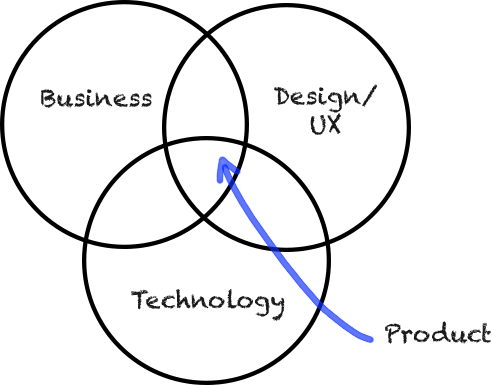
So let me take one more swipe at it. I like to think of these areas as three legs of a stool to sit on: you need to have skills present within each domain, but you don’t need to be a deep expert in any of the three. And if any of those legs gets too long, the whole thing topples over.
Why? So glad you asked.
First, if a Product Manager tries to become a deep expert in any of the three areas of their product, they’ve probably spent precious time in the weeds when they should really be operating at a higher (ahem, more general) level.
Second, by presuming to be an expert in any one or more areas they miss an opportunity to embrace the role of a learner and likely underutilize their team (who possess genuine expertise in the deep crevices of the product). Understanding all the pieces of the puzzle requires an attitude of curiosity, a commitment to learning, and the vulnerability to rely on the people around you.
Third, when a product manager presumes to be an expert in all three, they start to take on a lone-wolf persona and that kind of martyr behavior rarely gets you anywhere.
When I came up in product, I was very confident in my understanding of the business strategy, and reasonably confident in the tech stack we were working on. I had a lot to learn, however, about user-experience research and design. But because I knew this about myself, I built a team of experts across those specialty areas to help me fill in the gaps. In other words, I was smart enough to know that there were a lot of smart people around me who could help elevate the product to new heights.
If you’re struggling to strike this balance, here are 3 things you can do right now to become a great generalist.
Identify your strengths and opportunities
Start by evaluating the proportions of your personal Venn Diagram as they currently stand. Chances are, you’ll need to learn more about one leg of the stool to balance your generalist abilities. And here’s a key reminder: you will probably never have a truly-balanced diagram, and that’s okay! The point is to understand where you may need to build up some knowledge, then build a team of contributors and stakeholders around you. People go to school for a long time to understand every angle of these different specialities. You don’t need to pace with them, but you do need to be conversant enough in the discipline to know the questions to ask and the landmines to watch out for.
Figure out who needs to be in your corner, then build your team
Identify the resources who you can reliably call to say, “explain it to me like I’m in 5th grade.” Not only will this help you learn about new parts of the business or emerging technology, it will help you find people that will help you craft and tell a compelling story about your product.
Then, when it comes time to build your team, account for the fact that you need to complement your own skill set. Staff up more heavily in your opportunity areas so your team represents the optimal mix of experts.
Practice self-awareness
This will go a long way as you endeavor to become a great generalist. Be honest about what you know, and don’t overstate what you don’t. This is where that whole vulnerability component comes in. Only once you’re really honest with yourself about your knowledge gaps can you engage other folks and build meaningful relationships with people that can help you on your growth path.
While it certainly doesn’t happen overnight, the magic unfolds when you create a team of experts that rely on each other to ensure the three legs of the stool are well balanced across the team. I believe that this is at the heart of empowered, high-functioning, healthy teams.
At the end of the day, remember that you don’t have to know everything, but you do need to be able to demonstrate that you can lean on the experts around you to make the product better.