Don’t Let Your “Later” Roadmap Become Your “Never” Roadmap

I am THRILLED that Janna Bastow has offered to grace this space with a guest blog post. Janna is CEO of ProdPad, one of the tools I often recommend for product teams looking to move past Post-its and Sharpies as a way to organize all the ideas, asks, and general “someday” musings that product teams have to manage. She is also the creator of the Now, Next and Later roadmap concept, and for that we should all be eternally grateful. Enjoy!
~Jen
Whenever I talk to people about the Now/Next/Later format of the roadmap, I mostly get a good reception. People get it. It’s intuitive to think about our product strategy in terms of steps stretching out into further and further horizons.
The things in the “Now” are keeping the team busy today, with a combination of discovery and delivery work usually happening in a rapid cycle of building, measuring and learning.
The things in the “Next” column are usually the items that have been deprioritized out of the “Now.” The optimistic product person might try to cram it all in, but the realistic approach is to prioritize ruthlessly, keeping the team focused on just a few initiatives at a time to make sure they’re making an impact there first.
It's in the “Later” column where things start to get hairy. You see, it’s meant to be a place where the big audacious problems and opportunities live: an indication of the gold-topped mountains in the distance we’re meant to conquer if we’re going to fulfill our product vision.

What it becomes instead is Just Another Backlog: a holding ground for ideas and pet projects and problems of all different shapes and sizes, and the only thing they seem to have in common is that they aren’t being done “Now,” or even “Next.” They’ve ended up in the “Later” bucket, and frankly, with so much stuff in there, it may as well be called the “Never” column.
How did we lose our way?
First off, it’s important to remember that the Now/Next/Later roadmap is designed to replicate time horizons, analogous to horizons in the distance. The “Later” column represents work that’s way off in the distance—it’s fuzzy and hard to see, and only visible if it’s large and looming. Anything in the “Later” column should be high level and lack granularity—it’s too soon to start breaking it down into smaller chunks and, frankly, a waste of time and resources.
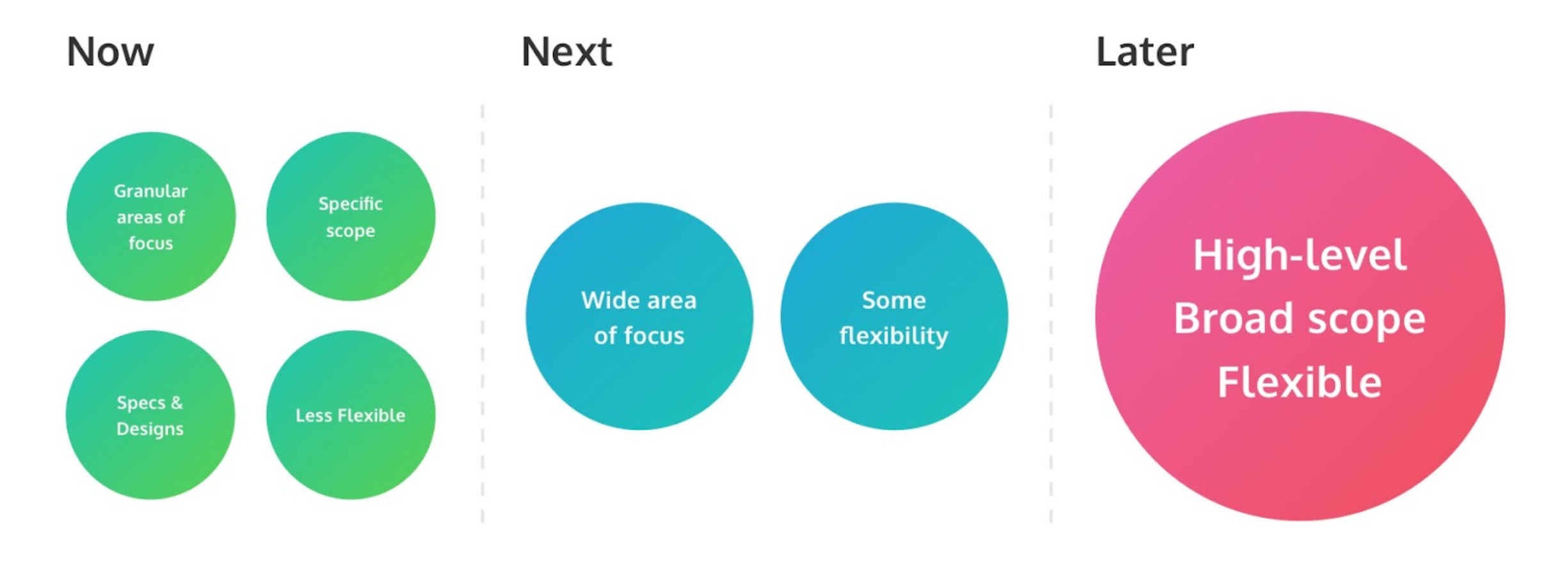
Too often, I see “Later” columns filled with dozens of disparate bits of potential product work, and no overarching themes to tie the work together into a cohesive direction. That’s not a product strategy. That’s just a backlog.
I think sometimes the “Later” column is used as a defense mechanism against uncomfortable conversations. Instead of telling your HiPPO “No,” it can feel easier to simply say “Not yet,” and put it on the roadmap for somewhere off in the distance. Future-you can deal with it when the time comes, and it gives you space to deal with the important discovery work that needs to happen NOW. But it’s not helping you in the long run.
Fundamentally, it comes down to not being stricter about the purpose of a roadmap. Your roadmap should be used not as a holding place for ‘someday/maybe’ ideas, and not as an alternative view or layer over your existing product backlog, but as a place to get clarity on your product strategy.
On the flipside, you’ve still got your idea backlog, and this is where your “Not yets,” “Maybe Laters,” “Need to think abouts,” and other unexplored opportunities live. A well-nurtured backlog is a treasure trove of insights, but shouldn’t be your driving force for your strategic decisions. Those decisions are driven by your vision, your objectives, and the steps outlined in your roadmap.
I like to think of the roadmap as a prototyping tool, but for your product strategy. You use your roadmap to outline your assumptions of the steps you think your company needs to take to make your product a success. Your first assumptions will be way wrong, and that’s okay. Just like your first prototype of a new interface is going to be wrong, the point isn’t to nail it on the first try, but to create an environment where you can gather more insight.
Take your first draft of your roadmap and share it with others on your team: your execs, your marketing team, your devs—whoever has knowledge of how your product works and where it sits in the market. Their feedback helps validate or invalidate your assumptions about the strategy, and helps you figure out what to add, remove, or adjust. Over time, and with ongoing conversations and iterations of the roadmap, you’ll move from having a flimsy product strategy to one that’s strong and validated.
One of the most powerful things a product person can do is lead an effective roadmapping process like this–one that’s ongoing and collaborative, and uses the collective knowledge of the stakeholders across the business and beyond.
To make sure that the “Later” column doesn’t become the “Never” column, keep the conversation high level when talking about strategic steps in the distance. Write them out as problems-to-be-solved, not solutions-to-be-built, and tie them back to your ultimate Why’s. They should give a sense of alignment with your product vision and with your high-level objectives.
And be accepting of the fact that not everything can, or should, be on the roadmap. Your roadmap is as much about saying “no” to the wrong things as it is about saying “yes” to the right things. Used well, your roadmap can help you validate your thinking about what’s going to be valuable and useful long before you start breaking those problems down into granular experiments and potential solutions.
And there’s nothing more lean than that.
Author bio:

Janna Bastow is the inventor of the Now/Next/Later roadmap and is co-founder and CEO of ProdPad, product management and roadmapping software for product people. Janna is also co-founder of ProductTank and Mind the Product, the global community of product managers. She often starts and stops conversations with the question: “What problem are you trying to solve?”