Mentoring as a Cornerstone of Professional Development
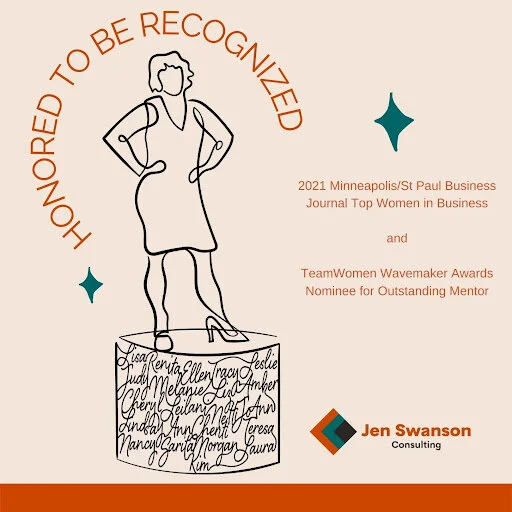
It's a big month for me. I'm honored to be counted in some truly amazing company, as one of the 2021 Minneapolis/St Paul Business Journal Top Women in Business, and as a nominee for the TeamWomen Wavemaker Award for Outstanding Mentor.
Both awards have special meaning for me, but the Outstanding Mentor nomination is extra special, as it gets to the heart of something that I have benefited from both receiving and giving.
I was nominated for this award by my favorite two badass women — my mom, a retired banking and fundraising professional, and my aunt, a former nurse, events business owner and Minnesota county commissioner. If you knew the success these women have had in their lives (and the hills they had to climb to get there), you would know just how affirming it is that they thought of me in this way.
Mentoring has been a cornerstone of my professional life. It is the thing that gave me confidence, helped me build skills, checked my BS when needed and showed me examples of professionalism that I wanted to exemplify. I have been mentored, and I have mentored others. Both have been powerful experiences that I am so, so grateful for.
Whether formal or informal, mentoring can be a catalyst for growing and being better at work, home, in relationships and as a human on this planet. Of all the things I am known for, I am most proud of being known as a mentor. It is an honor to get that call from someone saying, "Jen — I'm stuck. Can you help?" In fact, I get a charge from those calls in ways that make the long days of building and running a business much lighter to bear.
I’ve Benefited on Both Sides of the Mentoring Relationship
I’ve been lucky enough to count peers, academics, researchers, managers and even one CEO as my mentors. Some of those have been in formal relationships (I actually asked that CEO, “Will you be my mentor?” and his unequivocal “Yes!” was one of the most thrilling and gratifying moments of my career); others have grown organically out of close-knit working relationships, and were much more informal and episodic as my needs and their contributions ebbed and flowed.
Other times, I’ve been the mentor (again, sometimes formally, sometimes informally.) Here’s my secret, though — for every mentee that has approached me or asked me to help them navigate life, career, parenthood and the tangle of all three, I have learned as much from them as I hope they did from me.
I’m a firm believer that there is no “entrance criteria” to be a mentor — everyone can be a mentor to someone else. Early in my career, I ran a mentoring program through the University of Minnesota. When I approached recent grads to help mentor students, they looked at me like I was nuts. I remember one saying to me, "I am still a mess! I live with my parents and eat ramen six times a week ... no way am I qualified to mentor others." I had to remind them that they were fresh off their transition from student to working professional. Never again would they have more visceral feelings about what that transition took, and they owed it to those behind them to share what they were learning.
For me, mentoring others is an honor. But, I also know that I don't have to be perfect to be a mentor. My best contribution to a mentoring relationship is a good listening ear, openness and an authentic desire to help the other person grow.
Looking for a Mentor
As you search for a mentor, it is more likely that you will test out different options and have more success at getting others' commitment if you take a more formal approach. In this case, you might have a specific challenge or opportunity your potential mentor could help you with. Busy professionals are more likely to say yes if you give them some shape and context.
For example, imagine you've been assigned to create and execute a marketing plan for a particular project, but you've never done this before. You seek out a marketing expert who is willing to help you. You meet once a week for three weeks. Each meeting includes an update on what you've accomplished, feedback on the work you’ve done, consideration for what's next, and clear, actionable steps you will take before the next meeting.
Engagements like this tend to be quick wins for both you and the mentor. Plus, they are an excellent opportunity to test the relationship and see if you want to continue post-project.
Other relationships are more organic or episodic. You know the people you look to for guidance and advice, based on their lived and worked experiences. Asking questions and inviting guidance from their perspectives is a great way to start to explore a deeper relationship that has mentoring at its core.
Looking to Mentor Others
Let’s start here: do not try to mentor someone who doesn't want to be mentored. You can’t just walk around like Oprah saying, “YOU get a mentor, and YOU get a mentor!”
Instead, keep your ears open for people who are saying things like, "I'm struggling with this,” or asking you, “How did you handle this problem when you encountered it?” Offer to share your own experience, and practice asking them questions that will help them explore their own answers. A mentor is NOT a manager — you’re not so much telling them what to do as helping them discover how to do it. And you're probably going to discover something about yourself along the way.