The REAL Holy Grail of Product Management
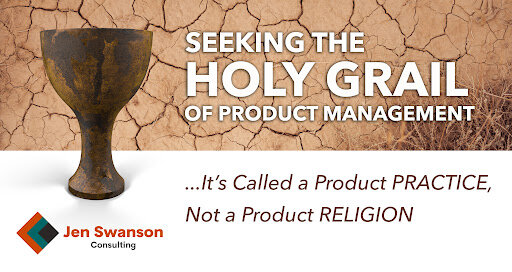
As digital transformations take root at companies of every size, stripe and measure, I’m seeing a disturbing trend that gets me really riled up. So prepare yourselves, but I feel a rant coming on.
Where there is digital transformation, there is usually an effort to move toward agile models of working. This includes, of course, frameworks like Agile Scrum, SAFe, Kanban, etc. And with those, there’s eventually a push to think about business alignment to technology in new ways — enter, product management. Google searches for definitions of these terms yield millions of results, widely varying but each promising fortune and glory for those who adopt.
As any good executive will tell you, they’ve been reading about the benefits of agile and product management in the publications crossing their desk over these last few years. Who wouldn’t want the kind of speed and agility (ahem) that these stories tout? Who wouldn’t want to be the “Uber of Manufacturing” or the “Netflix of Food Service”? (UGH. Separate rant. What do those even MEAN???
So they read a few books, talk to a few people, and decide they want in on the action. And they start looking for someone or something to help them transform.
Enter the frameworks. And the templates. And the dogma. There is a HUGE economy of consultants that are selling their “proven methods” and step-by-step recipes for transforming how an organization works. They developed it once, and now are seeking to re-hash it with the same cookie-cutter approach. They are the proverbial hammer, and every new client is the nail.
I’ve seen firsthand what this approach to transformation causes in a company, and in the teams working so hard to make it happen: a weakness of spirit, energy and innovation.
Teams are so concerned with following the recipes and frameworks given to them by external experts, convinced that even a minor variation will mean collapse and failure. It’s dogma, absent any context or situational awareness. It's lazy leadership, it's rigid operations and it's just plain lousy philosophy.
I'm wound up. (Can you tell?) It's so frustrating to see teams of talented, engaged professionals second guess their organic instincts because the supposed savviest of product leaders and consultants tell them they have to do everything just so in order to keep things from falling apart.
I truly believe organizations do need to transform and adopt product-based approaches and agile methodologies in order to succeed in our modern marketplace. But I want to be crystal clear: there is no single path to and through transformation.
Oh, how I wish it were so! A proven path would make it so much easier for leaders and teams to grasp the enormity and complexity of the change they must undertake. But the reality is that every company is different — and so must be their path of transformation.
Of course it’s smart to start with common definitions, frameworks, tools and structures. I’ve got them in my back pocket. But to adopt them wholesale, with no contextual adaptation for the particularities of your company’s culture, the market realities for your industry, or the history of change inside the organization? Failure is nearly guaranteed.
OK Jen, off the soapbox. What do we do instead?
Start by understanding that the challenges and opportunities your organization and your teams are facing are contextual and unique. Treat your transformation like a product itself — what problems are you trying to solve, and for whom? What is the value you are trying to realize as a result of this transformation? Ask yourself:
Where are the bottlenecks to getting things done (launches, releases, updates, etc.)?
Where are teams throwing work “at” each other, rather than working together?
Are there teams cropping up organically to work across the structures we’ve created? Why? Are they successful?
What problems could we solve if we worked across teams, rather than within them?
Does everyone in the company know who their customers are? And are they empowered and equipped to serve them?
You may find the answers surprising. I’ve seen teams come off a multi-year agile transformation in their technical teams, only to realize that the bottlenecks existed within business and operational silos. Or, I’ve seen them create complex project sequencing and prioritization schemes, only to discover that none of the priorities are actually solving customer needs.
The only true path to success lies in being honest about what’s broken, and then determining what YOUR teams and stakeholders need to fix it. They have to be engaged and empowered to be participants in the change, not handed it from above or from outside the organization. Shift the conversation to the outcomes — the behaviors and values that you want to bring to life — and then give them a suite of tools, frameworks and approaches that can help them do so.
As a product consultant, I provide dogma-free guidance in:
- Transformation strategy and approaches
- Finding better ways of working
- Getting closer to the customer
- Speeding up the time between knowing what you need to do and getting it done
- Getting teams to work better together
Please let me know how I can be helpful to you as you chart your own path through your transformation. And, watch for my next mastermind group, opening soon — this is a great opportunity to put your best and brightest product-minded folks in a room with others who have been there, done that and gotten the T-shirt — and can tell you what they learned along the way.